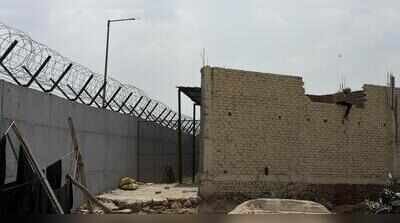









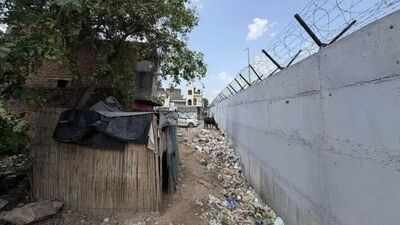
A 900-metre belt around the Indian Air Force’s ammunition depot in old Gurgaon, originally kept free of habitation as a security buffer, is now packed with homes and commercial buildings. In several places, multi-storey structures stand almost against the depot’s boundary wall, leaving little or no open space between the facility and surrounding settlements.The depot, established in 1947, is surrounded by 15 illegal colonies that have expanded over the years. The belt, spread across roughly 2,325 acres, now has residential buildings, PG accommodations, shops, schools, factories, cloud kitchens and other commercial establishments.In some stretches, five- to seven-storey buildings have risen close to the installation, providing elevated vantage points overlooking the depot. The dense construction has effectively wiped out much of the physical separation that the restricted zone was intended to provide.
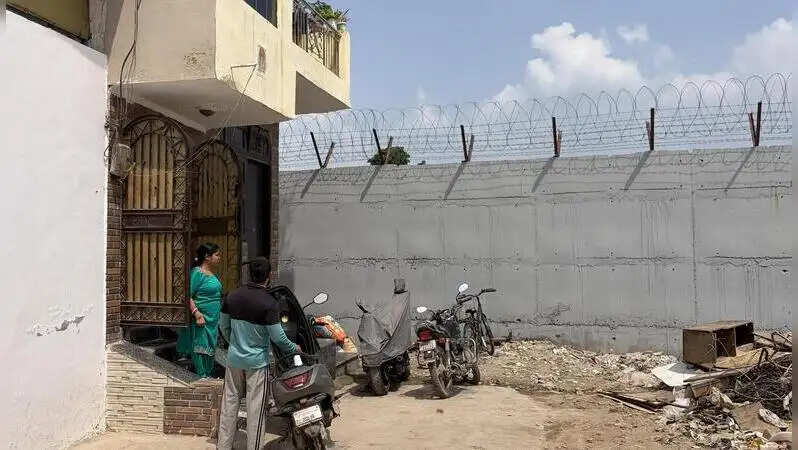
Image Credit: TOI
SC raises question over officials’ role
The issue came under scrutiny in the Supreme Court on Tuesday, with CJI Surya Kant questioning how construction was allowed to continue despite the restrictions.The CJI said the no-go zone had earlier extended beyond a kilometre before being reduced to 900 metres. Even after that, he said, illegal construction continued “right under the nose of the officials”.“Are the encroachments not because of the collusion of govt officials with the land mafia,” he asked.
Illegal structures run into thousands
The exact number of unauthorised structures has varied across government surveys and reports.An MCG survey conducted in 2017 identified 4,156 illegal structures within the belt. Officials now estimate that figure has roughly doubled. Older government data, including figures submitted before the high court, had put the total number of structures at 14,154.A more recent MCG report flagged over 5,000 unauthorised structures and more than 190 ongoing construction sites within the zone.The affected areas include Sheetla Colony, Rajiv Nagar, Sanjay Gram, Sukhrali Enclave, Ashok Vihar Phase 3, Om Vihar, Dharam Colony, Amanpura and Caterpuri, among others.
Court orders clash with ground reality
The Punjab and Haryana high court had earlier ruled that the 900-metre strip around the depot should remain free of urbanisation. It also found that authorities had allowed illegal construction to spread in the area, stressing that the depot was a strategic installation where national interest could not be compromised.Yet, government decisions over the years have also reflected the difficulty of dealing with the large population that had settled there.In 2015, Haryana filed an affidavit before the high court seeking to bring down the restricted area from 900 metres to 300 metres. The following year, the urban local bodies department approved temporary water connections for families living within the 900-metre belt, citing the difficulty of removing thousands of residents.In 2017, authorities were directed to remove encroachments within the narrower 300-metre radius. A subsequent survey identified 3,346 structures in that area, following which the high court ordered their removal.
Sealed buildings reopened, construction resumes
Recent enforcement efforts have also failed to stop construction completely.MCG sealed several buildings under construction last month. But when officials followed up, many of the structures had been de-sealed and work had resumed. Hundreds of buildings are currently under construction across the zone.
Residents point to civic services and voter cards
The settlements have developed many of the features of established urban neighbourhoods despite their status as illegal colonies.A Sheetla Colony resident of about a decade alleged that local politicians and officials encouraged poor families to invest in construction in the area.“They help residents get voter cards and then use them as a vote bank during elections,” he said.A woman living in the area said residents had repeatedly been given assurances about regularisation.“They help us get water and electricity connections. Roads have been built and sewerage laid,” she said.Another resident alleged that government development work meant for adjoining areas was effectively being carried out inside the restricted belt.“Tenders are issued for development work in adjoining areas, but the actual work is carried out inside the 900-metre zone,” this person said.
Restrictions become political issue
The restrictions have also become an issue for local politicians because of their impact on residents and property-related activity.During the 2024 assembly campaign, Gurgaon MLA Mukesh Sharma listed resolving the problems of the zone among his priorities. In June 2026, Sharma met defence minister Rajnath Singh and sought the Centre’s intervention, citing restrictions affecting civic works, property registrations and statutory approvals in the affected localities.
Faridabad faces another long-running case
The Gurgaon situation has parallels in Faridabad, where illegal construction around the Air Force Station in Dabua has been before the Punjab and Haryana high court for more than 15 years.In Jan 2010, the Centre notified a 100-metre restricted belt around the station under the Works of Defence Act, prohibiting construction within the area. Petitions seeking removal of illegal structures and action against officials responsible reached the high court the same year.The court directed Faridabad Municipal Corporation in 2012 to take action against the illegal structures. By 2017, authorities estimated that around 5,000 houses could be affected. A survey conducted in 2018 identified 2,717 buildings within the 100-metre belt.Authorities issued notices to occupants and were directed to prevent further construction and transactions. However, large populated colonies continue to exist, with the matter still caught in legal and administrative hurdles.
Security buffer turns into dense urban pocket
The Gurgaon depot’s restricted belt was intended to keep development away from a sensitive defence installation. Instead, it has evolved into a densely built-up urban pocket, with homes and businesses occupying land that courts have said should remain free of urbanisation.Civic infrastructure has also reached parts of the settlements, even as authorities continue to treat construction there as unauthorised.And with new buildings still coming up, the central issue now extends beyond how the colonies developed. It is how thousands of structures were allowed to remain, grow and receive civic infrastructure inside a security zone that has existed for decades.