









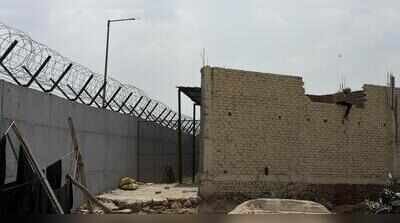
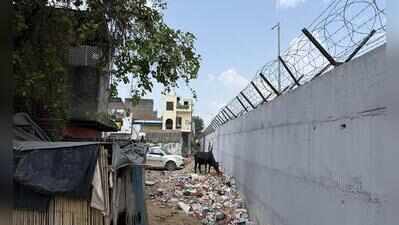
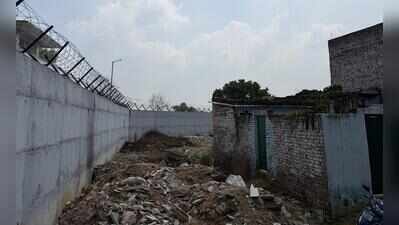
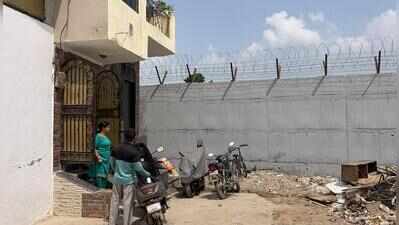
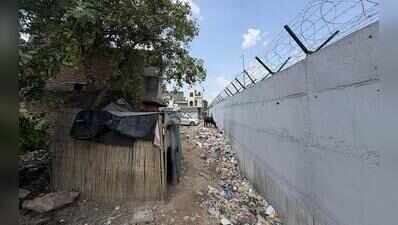
Gurgaon: The 900-metre restricted zone around Indian Air Force’s ammunition depot in old Gurgaon has been almost entirely built over, with multi-storey houses standing virtually flush against the facility’s boundary wall, leaving little to no buffer between habitation and a sensitive defence installation.Supreme Court on Tuesday criticised state officials for colluding with local land sharks to allow this encroachment. The depot was established in 1947.Fifteen illegal colonies have come up in the belt over the years, turning it into a dense urban pocket of kothis built cheek by jowl along narrow lanes. Residential buildings, PG accommodations, shops, schools, factories, cloud kitchens and commercial establishments now fill the zone. In several stretches, no open space separates the built-up area from the depot wall. Five- to seven-storey buildings have come up close to the installation, giving occupants elevated vantage points overlooking the depot — effectively erasing the physical buffer the restricted zone was meant to preserve.The affected pockets include Sheetla Colony, Rajiv Nagar, Sanjay Gram, Sukhrali Enclave, Ashok Vihar Phase 3, Om Vihar, Dharam Colony, Amanpura and Caterpuri, among others. The 900-metre zone covers roughly 2,325 acres.During Tuesday’s hearing, CJI Surya Kant said the no-go zone was earlier more than a kilometre and it gradually reduced to 900 metres, and even then, the illegal constructions were carried out right under the nose of the officials. “Are the encroachments not because of the collusion of govt officials with the land mafia,” he asked.Surveys and govt reports put the numbers differently. An MCG survey in 2017 identified 4,156 illegal structures within this belt. Officials estimate the number has since roughly doubled. Older govt data, including in the submissions made to the high court, had put total structures at 14,154, while a more recent MCG report flagged over 5,000 unauthorised structures and more than 190 ongoing construction sites in the zone.Punjab and Haryana high court had previously held that the 900-metre strip must remain free of urbanisation, and found that authorities allowed illegal construction to proliferate there. The court described the depot as a strategic installation where national interest could not be compromised.But govt action has repeatedly cut against this position. In 2015, Haryana filed an affidavit before the high court seeking to reduce the restricted zone from 900 to 300 metres. In 2016, the urban local bodies department approved temporary water connections for families in the 900-metre zone, citing the difficulty of removing thousands of residents.In 2017, authorities were directed to clear encroachments within a tighter 300-metre radius. A subsequent survey found 3,346 structures there, and the high court ordered their removal.MCG sealed several under-construction buildings last month, but a follow-up visit found many had been de-sealed and construction resumed. Hundreds of buildings are currently under construction in the zone.Residents describe a parallel civic ecosystem that has grown alongside the illegal settlement. A Sheetla Colony resident of about a decade alleged that local politicians and officials encouraged poor families to invest in construction there. “They help residents get voter cards and then use them as a vote bank during elections,” he said.A woman living in the area said residents have long been promised regularisation. “They help us get water and electricity connections. Roads have been built and sewerage laid,” she said.Another resident alleged that development tenders issued for adjoining areas are, in practice, executed inside the restricted zone: “Tenders are issued for development work in adjoining areas, but the actual work is carried out inside the 900-metre zone,” this person said.The issue has remained politically live. During the 2024 assembly campaign, Gurgaon MLA Mukesh Sharma listed resolving the zone’s problems among his priorities. In June 2026, Sharma met defence minister Rajnath Singh to seek the Centre’s intervention, citing the impact of the restrictions on civic works, property registrations and statutory approvals in the affected localities.A similar situation has played out near Faridabad Air Force Station in Dabua, where illegal construction within the restricted zone has been before Punjab and Haryana high court for over 15 years. The Centre notified a 100-metre restricted belt around the station in Jan 2010 under Works of Defence Act, prohibiting construction in the area. The matter reached the high court the same year through petitions seeking removal of illegal structures and action against officials responsible. In 2012, the court directed Faridabad Municipal Corporation to act against the illegal structures. By 2017, authorities estimated around 5,000 houses could be affected, and a 2018 survey identified 2,717 buildings within the 100-metre belt. Notices were issued to occupants, and authorities were directed to prevent further construction and transactions, but large populated colonies remain, with the issue still mired in legal and administrative hurdles.An area originally meant to stay free of urbanisation to protect a defence installation has become one of the city’s most densely populated pockets — serviced, in part, by the same civic machinery meant to keep it clear. With construction still underway, the unresolved question is not how the colonies came up, but how thousands of structures have been allowed to remain, expand and receive civic infrastructure inside a decades-old security zone.