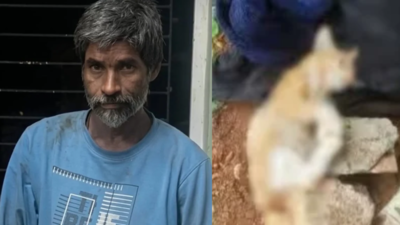









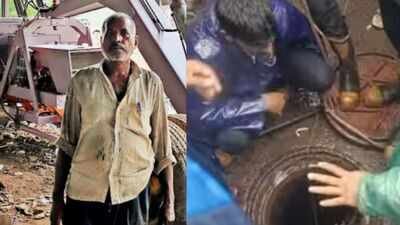
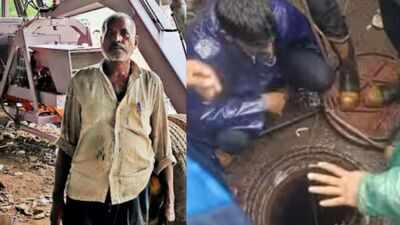
Arjun Chauhan (37) knows he should not be doing it. The contract worker from Panvel knows septic tanks and sewers are to be cleaned by machines, not people. He knows protective gear is mandatory. But when the call comes, he climbs in, with no safety cover.Chauhan has been doing this for 15-20 years, taking work from contractors, buildings and housing societies. A contractor pays him Rs 700-1,000 a day; others Rs 1,500-2,000. “There are lakhs like me who do this. After all, I have to put food on the table for my family,” he said.
Sewer deaths in Maharashtra
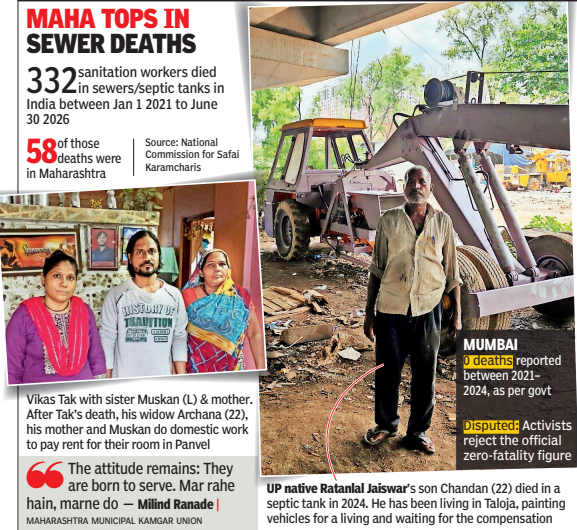
His story is the reality behind the ban on manual scavenging: people continue to enter septic tanks, and when they die, their families spend years waiting for the statutory Rs 30 lakh compensation.For Ratanlal Jaiswar (54), that wait began in Dec 2024, when his son Chandan (22) died cleaning a septic tank at a chawl in Uran. Chandan, along with Vikas Kisan Tak (33) who too died, had entered the tank to rescue another worker who had collapsed inside.An FIR lodged was against the contractor, a suction-truck owner and one of the homeowners-all of whom had employed them to clean the tank without safety equipment.Nearly two years later, Ratanlal paints vehicles for a living and is awaiting the money. He wants to leave Taloja and return to UP, where his family is, and use the money to get his four children married. “I don’t know how long I have to wait. Work dries up during monsoon, and when I don’t find work, I sit here and sleep,” he said.Tak’s family is struggling too. They say the police initially refused to lodge an FIR, while the suction-truck owner offered to take care of the deceased’s child’s education. However, the family maintained that it wasn’t enough as Tak was the sole breadwinner. His widow Archana (22), his mother and his sister Muskan now do domestic work to pay the rent for their room in Asudgaon, Panvel. Tak, who used to work as a driver-cleaner on the suction truck as well as do septic tank cleaning work, was paid Rs 17,000 a month, mostly in cash.“I want my five-year-old son to complete his education. He is now my only hope to get out of this situation,” Archana said.The same cycle has played out in other parts of Mumbai.In Powai, Akshay Mandal (23) andFulchand Kumar Saw (29) died in Nov 2025 while cleaning a sewage plant. “He was running the house. He used to send money so we could buy food and celebrate festivals,” his father Jaynarayan, who travels to Mumbai from Jharkhand each year for work, says. Mandal’s family got Rs 10 lakh from the contractor on humanitarian grounds but is awaiting the statutory compensation.Manual cleaning of manholes, septic tanks, and sewers is banned in India. But National Commission for Safai Karamcharis data shows 332 sanitation workers died in 18 states and UTs during hazardous cleaning of sewers and septic tanks between Jan 1, 2021 and June 30, 2026. Maharashtra had the highest number of deaths at 58. Data tabled in the House in July 2025 by the state showed zero deaths in Mumbai between 2021 and 2024; a figure disputed by activists. Centre too has maintained that a survey found no manual scavengers in India.“They want to hide the reality of caste-based discrimination. They don’t accept the situation of Dalits who do scavenging,” said Milind Ranade of Maharashtra Municipal Kamgar Union. He said the deaths reflect an indifference that has allowed the practice to persist. “The attitude remains: They are born to serve. Mar rahe hain, marne do.”In the case of Jaiswar and Tak, the state said that since a private contractor engaged them, the compensation must be recovered from the employer. Bombay high court, however, held in Aug that the state must pay even when workers are privately engaged, and can recover it later from employers. It struck down Item 11 of 2019 and 2025 GRs, which forced private societies or contractors to pay instead of the state.Meanwhile, some families are awaiting enhanced compensation after Supreme Court, in 2023, raised it to Rs 30 lakh and directed govts to provide rehabilitation, including employment for next of kin and education for children.Nearly seven years after three workers died cleaning a tank in Govandi in 2019, each widow received Rs 10 lakh, but the balance has been pending. “It should’ve been released automatically. We have been trying to reach the authority, but there is no response. The approach remains casual,” said advocate Abha Singh, who is pursuing the cases pro bono.Bezwada Wilson, national convenor of Safai Karmachari Andolan, says the delays show larger failure: “The govt has yet to acknowledge the extent to which manual scavenging continues, let alone identify those still trapped in it.”But for those still doing the work, the distinction between what is legal and what happens on the ground is less important than the next day’s wages. So when the next call comes, workers like Chauhan continue to climb into sewers.