






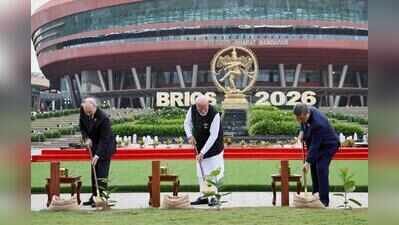
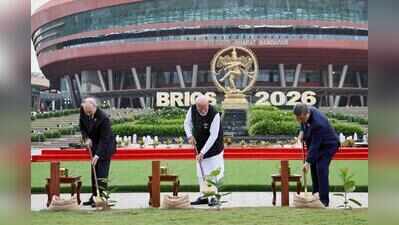
Chandigarh: When Narendra Modi, Vladimir Putin and Xi Jinping walked out to the lawns of Bharat Mandapam on Sept 12, they carried with them a legacy nurtured by three generations of a Ramgarhia family from Bareta Mandi, a small Punjab town better known for manufacturing farm tools than hosting international leaders. Sitting in his workshop, where he usually makes bespoke walking sticks, Gurnam Singh couldn’t help but smile as the Brics leaders dug up soil to plant banyan saplings.The shovels the international leaders were carrying had been made by Gurnam in his small workshop at Bareta Mandi.For Gurnam, now over 50, the moment was more than a proud one. The shovels at the centre of a global summit were the work of a family craft passed down through three generations. Gurnam’s father made them and so did his grandfather.Gurnam himself spent years making shovels, but today the family’s main business is quite different: handcrafted wooden and brass walking sticks, including customised pieces that, according to the family, find buyers even outside India. “The Brics order came almost as a return to the family’s roots,” says Gurnam.His 23-year-old son Jatin said one of their walking sticks had been gifted to someone in Delhi. From there, the family was contacted by the team handling the Brics ceremony.The family was initially asked to prepare two samples. Once the samples were approved, the requirement was finalised at 11 shovels, with the family asked to deliver them by Sept 8. There was barely any time. “We somehow managed to make them despite having only three-four days,” Jatin said.Within days, the made-in-Bareta Mandi shovels had travelled to Delhi. On Sept 12, they were used by Modi, Putin, Xi and other Brics leaders during the tree-planting ceremony.Bareta Mandi has long been associated locally with agricultural implements. Small workshops dealing with farm tools and machinery have been part of the town’s economy. Gurnam’s Ramgarhia family grew within that ecosystem, making tools for an agrarian market where the shovel was a basic necessity rather than a product likely to attract attention beyond the region.The Ramgarhia community has traditionally been associated with skilled craftsmanship, particularly carpentry, woodwork and metalwork. In Punjab, many Ramgarhia families turned these skills to agricultural implements, making and repairing tools used by farmers and rural households.That is why making a shovel itself was not remarkable for Gurnam. It was something he had done for years. “But now it is no longer our main business,” he said.The wooden-and-brass walking sticks Gurnam now makes have given the family recognition outside the local market. Social media, Gurnam adds, has scaled up the business. “Earlier, there were not many orders. Social media has brought them,” he says.It began with Jatin showcasing the family’s products on Instagram. Though started in January this year, the page for GS Agriculture Fabrication Works now has around 29,000 followers, turning a small workshop in Bareta into an online storefront. The family says enquiries and orders now come from different parts of India. “Orders from foreign countries also come a lot,” Gurnam adds.Though the family did not disclose the amount paid for the Brics order, they said a basic shovel cost Rs 2,000 a piece. The ones made by Gurnam involved a lot of moulding and woodwork, which added to the cost.For Jatin, the experience shows how different the family business is today from the one they inherited. “A generation ago, customers came to the family for farm implements. Today, customers can discover our work through a phone screen, send in specifications and place orders from thousands of kilometres away,” he adds.The demand has grown enough for the family’s Instagram page to carry an apology to customers for waiting and delays, along with a request for patience. Yet, when the unusual order came, the family returned to its oldest skill. Gurnam needed no refresher; his father and grandfather had taught him to make shovels long before Instagram existed. “The challenge was making 11 of them in just a few days,” he added.For now, the family has returned to its newer trade. Walking sticks remain the focus, with social media serving as a shop window and orders coming from beyond India. The shovels, meanwhile, have become a link between the family’s past and present — an old craft that is no longer its main business, but which briefly carried a small workshop in Mansa into the global spotlight.