




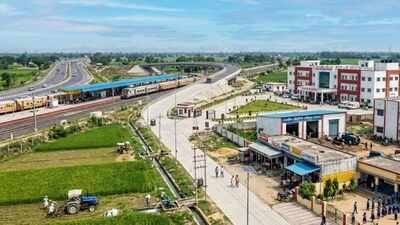
Maharajganj, situated in the Gorakhpur division of Purvanchal and sharing an international border with Nepal, has been witnessing a gradual but significant economic and developmental transformation over the last nine years.Historically known primarily as an agrarian and relatively backward border district, Maharajganj is now seeing improvements in infrastructure, investment, healthcare, irrigation, connectivity, employment generation and governance. While agriculture continues to remain the backbone of the district economy, the emergence of agro-processing, MSMEs, tourism-related activities and new investment proposals is gradually broadening its economic base.With an estimated population of over 2.75 million and an area of approximately 2,952 square kilometres, Maharajganj remains predominantly rural. Paddy, wheat, sugarcane, potato and oilseeds are among its major crops, while dairy and other allied agricultural activities provide additional livelihoods. The district’s economic transformation is therefore closely linked with the modernization of agriculture, improvement in irrigation and connectivity, and the creation of opportunities for farmers to move from primary production towards processing and value addition.The available economic indicators point towards a steady expansion of the district economy. District-level data at constant 2011-12 prices put net domestic product at Rs 7,274.61 crore in 2017-18 and 2018-19, rising to Rs 7,857.91 crore in 2019-20. At current prices, the corresponding figure increased from Rs10,602.76 crore to Rs13,109.74 crore. Other estimates place the district’s GDDP at around Rs14,618 crore at current prices in 2020-21, with the constant-price estimate at approximately Rs 8,742 crore. Later estimates have placed the district economy in the range of Rs 15,000 crore and above, depending on the year and methodology used. Although Maharajganj’s contribution to Uttar Pradesh‘s overall GSDP remains below one per cent, the direction of change is important because the district is progressing from a low economic base.This transformation is taking place against the backdrop of a much larger expansion of the Uttar Pradesh economy. The state’s GSDP has increased dramatically since 2017, with infrastructure creation, investment promotion, industrial policies and improved public services helping economic activity spread beyond the traditional industrial centres of western Uttar Pradesh and the National Capital Region. For districts such as Maharajganj, the benefits are particularly visible in improved road connectivity, investment proposals, rural infrastructure and access to government schemes.One of the most important changes has been the emergence of investment and entrepreneurship. Maharajganj’s industrial base remains dominated by micro, small and agro-based enterprises, but the scale of proposed and realized investment is increasing. Around Rs618 crore of realized investment has generated more than 4,000 jobs. In subsequent investment initiatives and Ground Breaking Ceremony-related projects, proposals amounting to approximately Rs 2,391 crore across nearly 188 units have emerged, with the potential to generate around 10,490 employment opportunities. Earlier rounds also saw investments of around Rs 787 crore, with 123 projects becoming operational and generating approximately 4,035 jobs.The character of these investments is especially relevant to Maharajganj’s economic structure. Rather than relying exclusively on large industries, the district is developing sectors that naturally complement its agricultural and geographical strengths. Rice mills, food processing, warehousing and agro-based enterprises are expanding alongside wooden furniture and small manufacturing. Hotels, resorts, educational institutions and medical-equipment-related activities are also emerging. This diversification can create local employment while reducing dependence on agriculture alone.The district’s wood-based products provide another avenue for economic development. The One District One Product approach has helped bring greater attention to local wood and wooden products, while the proposed and developing Common Facility Centre is expected to provide artisans and small enterprises with improved access to common infrastructure, technology and other facilities. Such interventions are important because they can help traditional skills evolve into commercially viable enterprises and enable local producers to compete in wider markets.Government-backed self-employment initiatives are also contributing to the changing employment landscape. Under programmes aimed at promoting entrepreneurship among young people, thousands of beneficiaries have received financial assistance and loans. In one reported period, around 2,625 beneficiaries received loans amounting to nearly Rs98 crore, supporting self-employment and additional job creation. Such initiatives are particularly significant in a district where large-scale industrial employment remains limited.Agriculture, however, continues to be the central pillar of Maharajganj’s economy. The district has substantial irrigation coverage through canals and government and private tubewells, enabling farmers to cultivate multiple crops. Paddy and wheat remain major food crops, while sugarcane, potato and oilseeds add diversity to agricultural production. The emphasis is increasingly shifting from merely increasing production to improving the value realized by farmers through storage, processing and market linkages.The district’s agricultural potential is further strengthened by its location. Its proximity to Nepal provides opportunities for cross-border trade, while the production of rice, potato, onion and wheat has created possibilities for wider domestic and external markets. During one reported period around 2020-21, the district’s agricultural export value was cited at more than Rs1,100 crore, including significant quantities of onion, potato, rice and wheat. The development of food-processing units and warehouses can further strengthen this agricultural value chain.Connectivity has emerged as another major driver of change. The improvement of roads, particularly the Gorakhpur-Sonauli corridor, has reduced travel time and improved access to markets and services. Better connectivity is crucial for a border district because it facilitates the movement of agricultural produce, raw materials, manufactured goods and people. Bridges and other infrastructure projects have strengthened links between rural areas and urban centres, while projects such as the Banelia Mai barrage on the Rohin river have combined irrigation and connectivity benefits.Near-universal electrification of villages has further improved the environment for rural economic activity. Reliable power is essential for irrigation, small manufacturing, food processing, cold storage and household enterprises. Improvements in basic infrastructure therefore have a multiplier effect, enabling both agriculture and non-farm activities to expand.Healthcare has been another important area of transformation. Maharajganj, like several districts of eastern Uttar Pradesh, had historically faced serious healthcare challenges, including Japanese Encephalitis. The expansion of healthcare infrastructure, improved disease-control measures and the operationalization of a medical college have strengthened the district’s medical ecosystem. Better healthcare not only improves quality of life but also reduces the economic burden of illness on rural families.The development agenda is also extending towards tourism and the border economy. With its proximity to Nepal and its location in the culturally rich Purvanchal region, Maharajganj possesses opportunities for religious, ecological and border tourism. A proposed multipurpose hub near the Nepal border, incorporating tourism, healthcare and commercial facilities, could potentially give another dimension to the local economy if implemented effectively.An important feature of Maharajganj’s progress has been the strengthening of governance and monitoring. The district has frequently performed well on the Chief Minister’s Dashboard in development works and revenue administration. Improvements in the implementation of schemes related to education, health, nutrition, sanitation, roads and agriculture indicate that development is increasingly being monitored through measurable outcomes.The transformation of Maharajganj should nevertheless be viewed realistically. The district remains predominantly dependent on agriculture, per capita income is comparatively low and large-scale industry is still limited. Its economic growth starts from a relatively low base, and there are gaps in the availability of comparable long-term district-level economic data. The challenge ahead is therefore to convert infrastructure and investment proposals into sustainable enterprises and employment.The next phase of Maharajganj’s development can build upon its inherent strengths. Agro-processing, food storage, rural enterprises, wood-based products, skill development, border trade and tourism offer promising avenues. Better market linkages can enable farmers to capture greater value, while MSME support can encourage local entrepreneurs to create jobs within the district.Maharajganj’s journey over the past nine years is thus not a story of overnight industrialization, but of gradual economic restructuring. Roads have improved, healthcare infrastructure has expanded, irrigation and basic services have strengthened, investments are increasing, and young people are being encouraged towards entrepreneurship. From an agrarian border district constrained by weak infrastructure and limited industrial opportunities, Maharajganj is steadily building the foundations of a more diversified rural economy. Its future growth will depend on how effectively these foundations are converted into productive investment, higher farm incomes, local employment and stronger integration with the markets of eastern Uttar Pradesh and neighbouring Nepal.(District Transformation)