








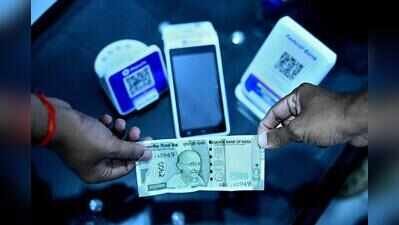
Noida/Ghaziabad: Traders across Noida, Ghaziabad and Delhi have opposed Centre’s newly introduced 0.4% merchant discount rate (MDR) on specified UPI transactions above Rs 2,000, saying the charge will squeeze already-thin margins and could ultimately push businesses to pass on the cost to customers.“The load on traders keeps growing, and it’s unclear when it will ease. Customers won’t feel any relief either, since every transaction above the threshold will now carry an extra charge. Earlier, MDR applied only to card payments — now UPI will attract it too,” said Atul Mehra of ARM Jewellers in Sector 18. He urged govt to review the decision in the interest of traders.Under the revised framework, effective Oct 15, MDR will apply to specified person-to-merchant (P2M) UPI transactions above Rs 2,000. The charge will be capped at Rs 300 per transaction for payments of Rs 75,000 and above. UPI payments between individuals will remain free, while merchant payments up to Rs 2,000 and eligible small merchants covered under the zero-MDR framework will remain outside the levy.SK Jain, president of the Sector 18 Market Association, said the charge could eventually be reflected in prices even if it is not directly imposed on customers. Citing industry figures, he said UPI transactions were worth Rs 314 lakh crore last year, of which payments above Rs 2,000 accounted for Rs 207 lakh crore.“India accounts for 49% of global digital payments, with UPI facilitating 83.7% of domestic digital payments. We request govt to rethink the charges, as this could discourage digital payments,” Jain said.Brijesh Goel, chairperson of Chamber of Trade and Industry, said traders had spent years shifting customers towards digital payments. “In the past six years, we have with great difficulty brought even the smallest shopkeepers and street vendors onto UPI. Today, 90% of payments in Sadar Bazar, Chandni Chowk, Lajpat Nagar, Chawri Bazar, Kamla Nagar, Karol Bagh and Gandhi Nagar are through UPI. If MDR is imposed, it will be a setback to Digital India mission,” he said.Amit Gupta, general secretary of New Delhi Traders Association, said traders were not opposed to digital payments but feared the additional cost would encourage cash transactions. “UPI was introduced to make digital payments easier for both traders and customers. If traders are now asked to bear an additional charge on transactions above Rs 2,000, many of them will prefer cash payment,” he said.Not all traders view the charge as a major disruption. Atul Bhargava, president of New Delhi Traders Association, said its impact on businesses in Connaught Place would be limited, particularly where goods are sold at MRP.“As far as Connaught Place is concerned, the 0.4% charge won’t make much difference if we’re selling at MRP. It isn’t a large amount, and running the system does involve costs — after all, one pays more on credit card transactions. Govt will certainly make money from this, but I feel some administrative charge is reasonable to sustain any system,” he said.Sudhir Srivastava, vice-president of Noida Entrepreneurs Association, said the concerns of small and low-margin businesses should be weighed against the cost of maintaining the UPI infrastructure.“The primary concern is the additional cost it may impose on small businesses and low-margin merchants, and this concern should not be overlooked. At the same time, maintaining a large-scale digital payment infrastructure that is secure, fast, reliable and continuously evolving involves significant costs,” he said.Srivastava said UPI could be compared with card networks such as Visa and Mastercard, which also operate with transaction-related charges. “The real issue is not simply whether MDR should exist, but what its structure and impact should be,” he said.Gulshan Makan, president of Jawahar Gate Vyapar Samiti, which represents more than 100 traders in Ghaziabad’s old city, said the decision would have a cascading impact on small businesses and consumers.“This is an ill-advised decision that will have a cascading effect, from consumers to small-time traders. At a time when inflation is already high, this could further fuel prices. We protest this decision,” Makan said.Ghaziabad-based trader Mohammad Nazim said the charge could add up quickly for businesses handling several high-value UPI transactions each day.“The 0.4% charge may look minuscule, but we do transactions of Rs 2,000 or more with more than 90 customers on an average. When you calculate it, the amount will burn a hole in our pockets,” he said.The concern is also relevant for businesses that use UPI for both receiving payments and paying suppliers. Pawan Yadav, a Gurgaon-based restaurant owner, said his establishment receives around Rs 30,000-35,000 through UPI every day and makes purchases worth around Rs 70,000 through the platform.Across Delhi markets including Kalkaji, Kamla Nagar, Khan Market, Laxmi Nagar and Sadar Bazar, traders said the prospect of an additional transaction cost had fuelled uncertainty over who would ultimately bear it, with some fearing that businesses could shift back towards cash.Traders said the impact would be particularly significant for businesses with low margins and a high volume of digital transactions.“Our profit margin is around 3-4%. We will have to increase our making charges to absorb the additional cost. Ultimately, the impact will be felt by customers,” said Amit Maheshwari, who runs a jewellery store in Gurgaon’s Sadar Bazaar.Ayush Mittal, another trader, said passing on the cost would create difficulties. “No trader will want to bear this cost, and we may have to load it on customers. It will be tough to explain the additional charge to them,” he said.Rajender Verma, owner of Sri Ram Jewellers in Sector 18, said govt should consider simplifying the overall tax and payment structure. “We used to hear slogans like ‘one nation, one tax’. If all these separate taxes were removed and replaced with a single transaction charge instead, govt could also save on the costs of collecting TDS, GST and the rest,” he said.