








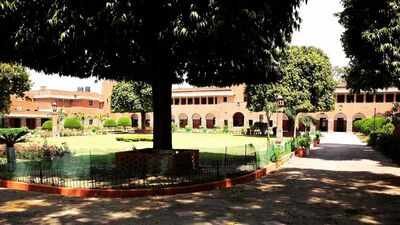
Long before St Stephen’s College became one of Delhi’s best-known institutions, its first classrooms were inside a historic haveli in Chandni Chowk. In 1881, the college began with just five students and three teachers at Katra Khushal Rai in the Walled City. The building was known as Sheesh Mahal, an 18th-century Mughal-era haveli. It had earlier been associated with Ashraf Beg, described as one of Emperor Bahadur Shah Zafar’s favourite wazirs. The building later became the site of St Stephen’s School in 1841, before the college was established there four decades later. What started on a small scale would eventually grow into one of Delhi’s most prominent colleges.
Just five students in the first batch
When St Stephen’s College opened in 1881, there were only five students and three teachers. The institution was founded by the Cambridge Mission to Delhi and was initially attached to Punjab University.The college remained in the Chandni Chowk area during its early years before moving to other locations as it expanded. Its first decades coincided with a period when Delhi was undergoing major changes following the events of 1857. The institution gradually established itself as an important centre of higher education in the city.
The college moved out of Chandni Chowk
St Stephen’s did not remain in the old haveli permanently. In 1891, the college moved to a building near St James’ Church at Kashmiri Gate, where it remained for decades. The move reflected the institution’s growth from its modest beginnings in the Walled City. The college later became part of the University of Delhi after the university was established in 1922. Eventually, St Stephen’s moved to its present campus in Delhi’s North Campus.
How important is it to preserve historical buildings like Sheesh Mahal?
3k+ users shared opinion today
5k+ users already voted today
3k+ users shared opinion today
The old haveli remained in Chandni Chowk
While the college moved on, its first home remained behind in the crowded lanes of Old Delhi. By the time the building was revisited for restoration plans in the 2000s, Sheesh Mahal was being described as a historic structure that had lost much of its original character. Plans were drawn up to restore the building and preserve its connection with St Stephen’s College. The restoration effort was significant because the building represented not only the early history of the college but also a surviving piece of Chandni Chowk’s older architectural landscape.
A small beginning, a much bigger institution
St Stephen’s would eventually become known for producing generations of academics, administrators, politicians, writers and other public figures. But its beginnings were far removed from the large institution associated with its name today. The college that began with five students and three teachers in a Chandni Chowk haveli in 1881 eventually moved through Kashmiri Gate before reaching its present campus. The old Sheesh Mahal remains a physical link to that earliest chapter — when one of Delhi’s most prominent colleges was still a tiny institution operating from a historic haveli in the heart of the Walled City.